
Sandwiched between the Lok Nayak Hospital and the bustling locality of Chandni Chowk lies Asaf Ali Marg, an old and dingy road that houses a number of banks, shops, and bookstores. To the east of this street lies the Feroz Shah Kotla Stadium, whereas the Lal Quila is just a few miles to the north. The area itself needs no introduction–soaked in almost 500 years of rich history, Asaf Ali Marg is one of Delhi’s oldest areas which even today is a vivid reflection of its past, where the old and the new exist together as a conjoint whole of two different bodies, inhaling the same air and using the same organs.
In the 1950s, this street became one of the most important recreational areas of Delhi, which was flooded with tourists from all over the globe. The rich history of its nearby marvels roped in thousands of people every year. At the end of the 1950s, a high rise emerged a few miles away from the historic Delhi Gate that was soon to become an iconic part of Delhi’s skyline.

Source: https://www.makemytrip.com
Hotel Broadway was set up by Tirath Ram Amla—a politician from Jammu and Kashmir—at Asaf Ali Road in 1956. In its nascent years, Hotel Broadway entertained a plethora of patrons, from foreign tourists to Bollywood celebrities. You could book a single room with a bed and breakfast at only Rs. 15/-.
However, it was only in 1990 that “Chor Bizarre”—a pun on the thriving chor bazaar only a few minutes away from the hotel—was opened. The chor bazaar was the source for mismatched furniture, antiques, soup bowls and cutlery. This ‘junk’ became the defining feature of the restaurant and tourists flocked to experience it for themselves. At one point, a 1927 Fiat Balilla stood in the centre of the restaurant and served as a salad plate. A bar called ‘Thugs’ was set upstairs and true to its name housed multiple portraits of famous Hindi film villains. Cocktails called ‘Mona Darling’ and ‘Lilly don’t be silly’ were the highlight of the menu.
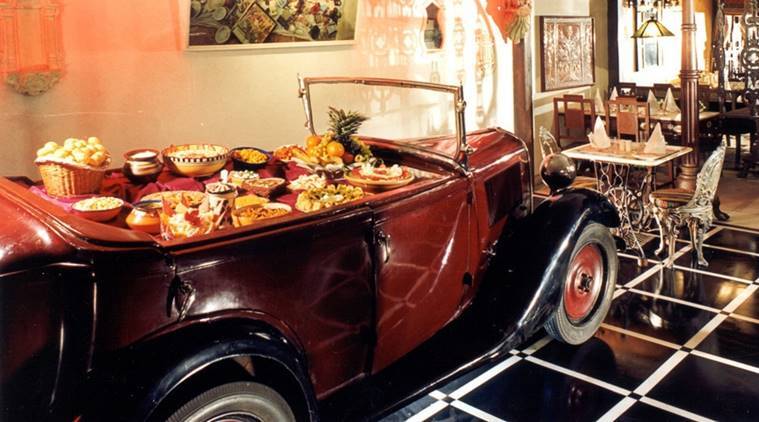
Source: https://indianexpress.com/article/cities/delhi/pandemic-fallout-home-to-thugs-chor-bizarre-delhi-loses-a-landmark-in-hotel-broadway-6906236/
With Mohammad Rafi playing in the background and surrounded by antiques the restaurant became a microcosm of Delhi in the 1900s. Time stood still inside Hotel Broadway as the Delhi outside metamorphosed into what we know today.
Hotel Broadway survived well into the 21st century, but the global pandemic gradually caught up to it. The conjoint bodies, so far untouched by the vicissitudes of the outside world, began to wither as the pandemic raged on in the first few months of 2020.
The Covid-19 pandemic severed the veins of old businesses like the Broadway, which succumbed to consistent but unrelenting economic failures. Completely dependent on its foreign tourists, the nationwide lockdown initiated by the Indian Government in late March 2020 resulted in the closure of both national and international borders. The more days the country spent under the lockdown, the more cash flow issues sprang up at the Broadway. However, when the lockdown was finally lifted, Hotel Broadway was too injured to get back on its feet. With no way forward, the management decided to shut its doors, never to be opened again.
Before the Daryaganj Sunday Book Market was shifted to its new sprawling location across the street from the Broadway, book-sellers would line up along Asaf Ali Marg, running all the way from one end of the street to a few blocks after Broadway Hotel. A visit to the book market on Sunday revealed the true cosmopolitan essence of Delhi, where one could see a number of foregin tourists sharing a friendly smoke at the nearby paan-wallah or sifting through ‘original first copies’ of the latest books. Most of these tourists would be patrons of the Broadway, who were completely lost due to the pandemic.
“Since the running of… is no longer economically viable, the management is constrained to close down the same with effect from 21st May… workmen are being paid closure compensation…” says the paper pasted on the glass-door of the hotel marking the end of the last remnant of what Delhi once was. Now we will speak of Hotel Broadway in the past tense, referring to it as a historical relic that succumbed to forces beyond its control. It has earned and occupied a page in Delhi’s history. As places like the Broadway are gradually shutting down, the ‘old’ gives way to the ‘new’, and all the beauty of co-existence is receding. The body that existed in a perfect equilibrium with the old and the new is severed, and new independent bodies take their place.
 Dastaan-E-Dilli